we've languaged successfully
I've decided I mostly disbelieve in "bad grammar," and that people who write things like this grammarian's lament are doing something different from what they claim they're doing (perhaps unknowingly).
Language is a biological phenomenon that happens in meat. It's kind of miraculous that there are rules we can articulate at all. If an idea gets from my head to yours, then you and I have languaged successfully.
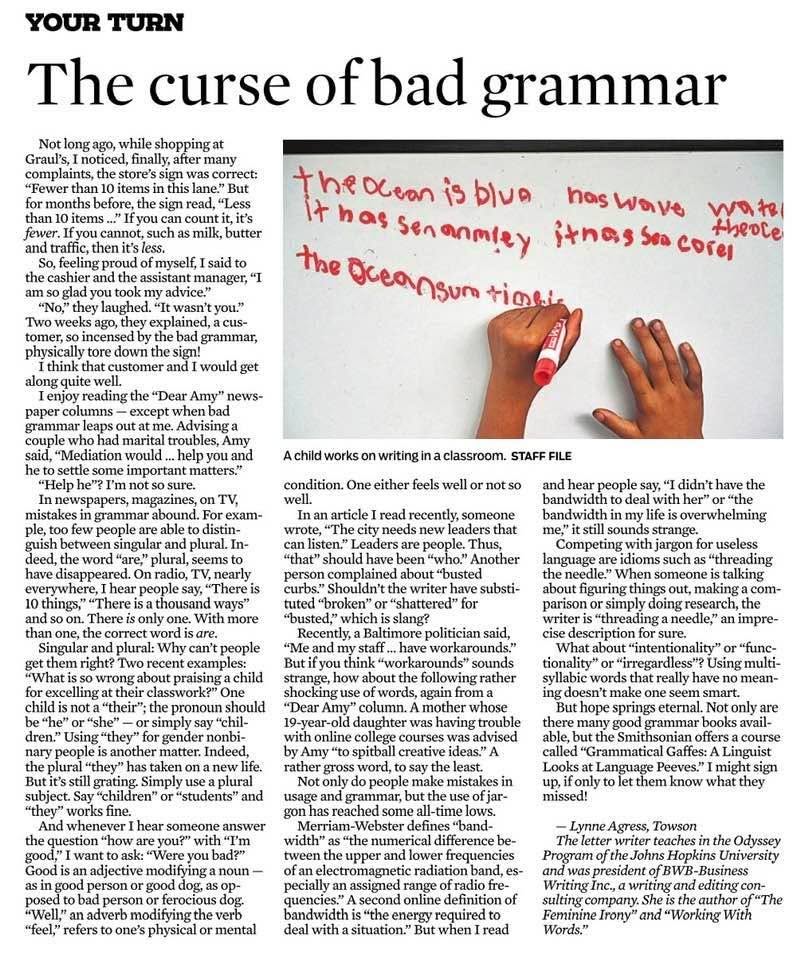
(The article seems to want a paywall, but here's a picture of it.)
Biologically, language is almost certainly an "exaptation" of vocalizations that served other purposes in our predecessors. One of those preexisting purposes, still displayed in our nonhuman cousins, is social group identification. We do this too, automatically and often unconsciously. Think of the last time a stranger approached you on the street and asked for directions: perhaps they said "Excuse me, which way is the." Even before the end of the sentence, you had probably formed an opinion about what part of the world they grew up in, and possibly an opinion about how long they had gone to school.
And what's happening in this "fun" little article is some weirdly aggressive classism about school. If my sign says "ten items or less" when you would prefer it says "ten items or fewer," we have still languaged successfully. There is zero chance you saw "or less" and thought "what on earth does that mean" — you just wish that I had phrased it differently. A person who tears down the store's sign is violating a very different set of social norms than the person who uses a different word. I have an opinion about which set of social norms is more important.
The example of "it would help you and he to settle matters" follows a clear logic. "It would help you" is natural and correct, while "it would help he" is jarring to most people: it feels like there should be another word coming. If you were constructing a logical argument you would preserve the case when combining the two, and say "it would help you and him." But there are millions of English speakers who are apparently using different logic. What is this logic? That is a science question, not a problem to be solved. How, exactly, does the language-meat work?
The author says that the pronoun "they" has "taken on a new life" as a singular pronoun for people whose gender doesn't fit the usual male/female binary, but that this usage is "grating." This is just not consistent with the evidence from history nor usage. Singular "they" has been in continuous use in English for longer than singular "you": there were grammar books prescribing "thee" and "thou" instead of singular "you" published in the early 1900s. Did you notice when I used singular "they" earlier in this little essay? I bet a nickel you didn't, so I'll do it again.
Most importantly: a person who cannot discuss their gender nonbinary acquaintances without "grating" at their pronouns, and whose feelings about words are stronger than their feelings about property or decorum, is a person who cannot be trusted not to transfer that "grating" feeling to the acquaintance as an individual, or to gender nonbinary people as a class.
I used to be a snob about using proper Schoolbook English. I still speak and write Schoolbook English, unless I'm breaking a rule for rhetorical effect. But I'm done being a snob about it. If you're a grammar elitist, I invite you to reconsider your motivations.